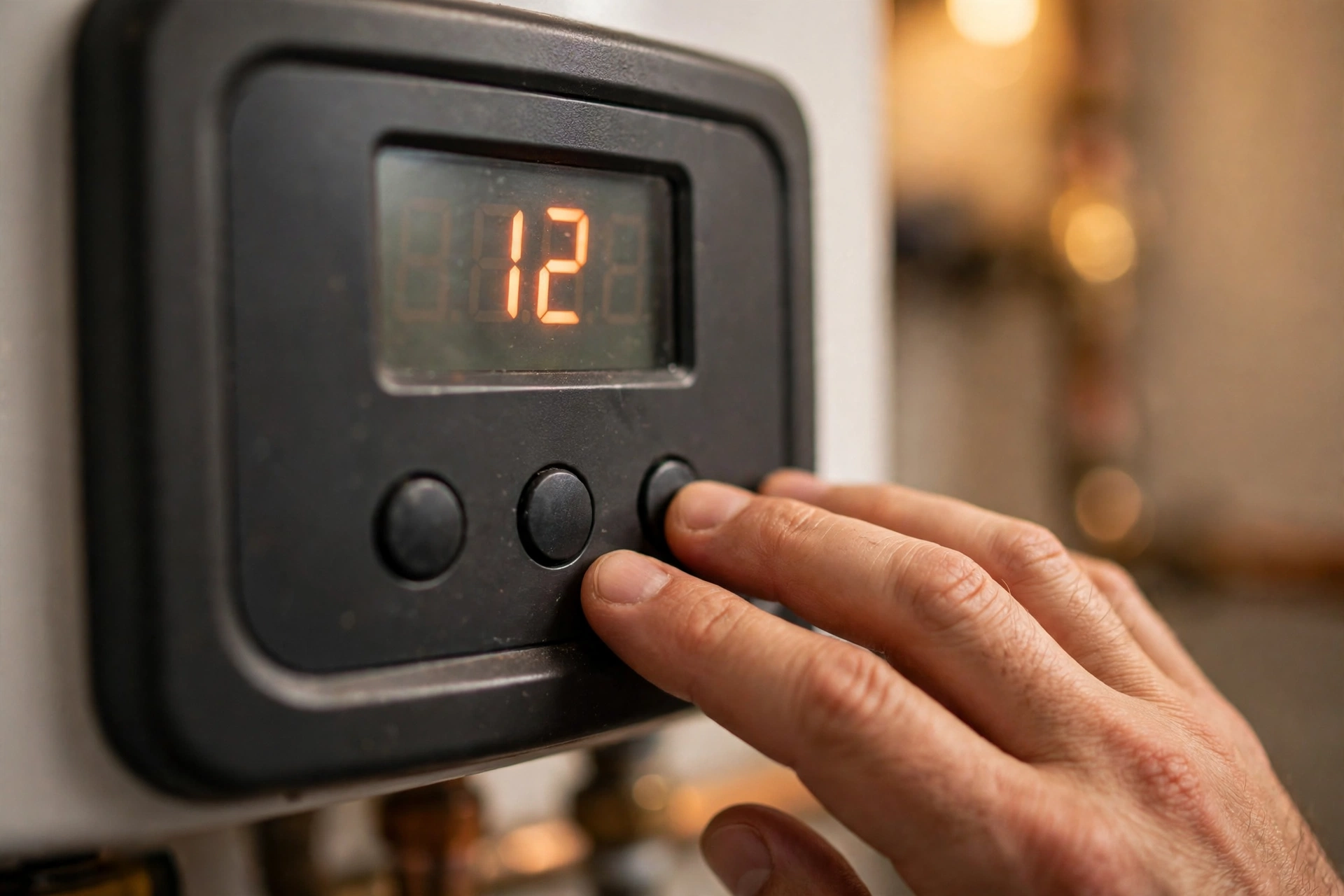
A tankless water heater error code is the unit telling you where to look. Rinnai, Navien, Noritz and Rheem all show codes when something is wrong — ignition failure, flame loss, overheating, a blocked vent, a clogged filter. The tables below list the common ones.
Before anything else: write down the exact code, and the brand. A code that looks the same on two brands can mean different things, and a code that is one digit off is a different fault. If the unit is showing a code and there is no hot water, a gas smell, or water leaking, call (877) 418-1589 and read the code exactly as it appears.
What to check first, whatever the code
Five checks fix a surprising number of codes, and they take a few minutes. Do them before you call, and mention what you found.
- Gas supply on. The gas valve fully open, other gas appliances working.
- Water supply on. The cold-water valve to the unit fully open. A unit that cannot get water cannot heat it.
- Power on. The unit plugged in, the breaker not tripped, the display lit.
- Inlet filter clean. A clogged filter starves the unit of flow.
- Vent clear. Nothing blocking the intake or the exhaust.
Then reset once: turn the unit off, wait a minute, turn it back on. If the code comes back, stop resetting it.
Codes you can usually handle yourself
A small group of codes point at maintenance, not at a broken part.
Maintenance reminders. Navien's W003 is the clearest example: the unit is asking for a flush. It is not an error — it is a countdown of the hours since the last flush. The fix is a flush.
Clogged air intake filter. Navien's E438 means the air intake filter is clogged. Cleaning the filter and resetting once is the usual fix. If the code comes back, the fault is deeper — a fan or a sensor — and that is a provider's job.
Scale buildup. Rheem's 1L means lime and scale have built up in the heat exchanger. The fix is a flush and descale — on a unit that is still heating, a flush is the right first step.
Low water flow. Rheem's P1 means the water flow is too low for the unit to run. Check the inlet filter and the cold-water valve. If the flow is fine and the code stays, the flow sensor itself may be the fault.
Blocked vent or intake. Rheem's 05, Rinnai's 10 and 25, and Navien's E110 all mean the air intake or the vent exhaust is blocked. Look at the vent terminal outside: a nest, ice, leaves, or a plastic bag can all do it. Clear what you can see safely, reset once, and if the code returns, call.
Codes that need a technician
The rest of the codes point at a part, and parts are a provider's job.
No ignition and flame loss. Rinnai 11 and 12, Navien E003 and E012, Noritz 11 and 12, Rheem 11 and 12. The burner will not light, or it lights and goes out — usually the igniter, the flame sensor, the gas valve, or gas pressure. Either way, the unit needs opening, and a gas unit is not a thing to open up yourself.
Overheating. Rinnai 14 and 16, Navien E016 and E030, Noritz 14, 16 and 20, Rheem 1L. The unit is getting too hot, usually because scale is insulating the heat exchanger from the water. A flush is the first step, but a code that comes back after a flush means something else is wrong.
Combustion problems. Rinnai 13, Noritz 90 and 99, Rheem 13. The burner is not burning cleanly. Stop using the unit and call — abnormal combustion is never a wait-and-see problem.
Board, fan and servo faults. Noritz 61, 65, 66 and 73, Rheem 61 and 99 and 65, Rinnai 65, Navien E010. A fan motor, a water control servo, or a circuit board — part replacements, and the part has to be the right one for the model.
Common error codes by brand
Every code below was verified against manufacturer documentation. Read the code exactly as it appears on your unit, and match it to the brand on the unit — not to another brand's table.
Rinnai
| Code | What it means |
|---|---|
| 10 | Blocked exhaust or air supply — venting is restricted |
| 11 | No ignition — the burner will not light |
| 12 | Flame failure — the flame lit, then went out |
| 13 | Abnormal combustion — the flame is not burning cleanly |
| 14 | Thermal fuse tripped — the unit overheated |
| 16 | Over-temperature — outgoing water is too hot, often scale |
| 25 | Venting or condensate blockage |
| 65 | Water flow control fault |
Navien
| Code | What it means |
|---|---|
| E003 | Ignition failure — the unit cannot light |
| E004 | False flame detection |
| E010 | Venting or air-pressure fault |
| E012 | Flame loss during operation |
| E016 | Heat exchanger overheating — often scale |
| E030 | Exhaust overheat |
| E110 | Exhaust or intake vent blockage |
| E438 | Clogged air intake filter |
| W003 | Maintenance reminder — a flush is due |
Noritz
| Code | What it means |
|---|---|
| 10 | Combustion abnormality |
| 11 | Ignition failure |
| 12 | Flame loss during operation |
| 14 | Thermal fuse failure |
| 16 | Abnormally high outlet water temperature — often scale |
| 20 | High-limit switch tripped — overheating |
| 29 | Condensate or neutralizer drain problem |
| 59 | Low gas input — combustion is starved of air or gas |
| 61 | Fan motor fault |
| 65 | Main water control servo fault |
| 66 | Bypass water control servo fault |
| 73 | Circuit board setting fault |
| 90 / 99 | Combustion abnormality |
Rheem
| Code | What it means |
|---|---|
| 1L | Lime and scale buildup in the heat exchanger |
| 05 | Air intake or vent exhaust blocked |
| 11 | No ignition — gas valve not open or no gas supply |
| 12 | No flame — gas service interrupted or low LP gas |
| 13 | Poor or improper combustion — flame rod fault |
| 29 | Neutralizer clogged |
| 61 / 99 | Blower motor fault |
| 65 | Water flow solenoid fault |
| P1 | Water flow too low to run the unit |
What a code does not tell you
A code is a clue, not a diagnosis. Two different faults can show the same code: Rinnai 12 — flame failure — can mean a dirty flame sensor, a gas pressure problem, or a venting fault.
A code also cannot tell you how bad the fault is. A 16 on a unit that has never been flushed is usually scale. The same code on a unit that was flushed last month is something else.
And a code cannot tell you whether the unit is worth repairing. That is answered by what the fault is, what the part costs, and how old the unit is.
When a code is urgent
Most codes can wait for a visit. Three situations cannot. If you smell gas, leave the area and call your gas utility's emergency line from outside. If water is leaking from the unit, shut the water off to the unit and call. If there is no hot water at all and the unit will not fire, call.
Everything else sits in between. A maintenance reminder is not urgent. A code that comes back after a reset is a visit — soon, but not an emergency.
Questions people ask
What does my tankless water heater error code mean?
It depends on the brand and the code. Rinnai 11 means no ignition; Navien E003 means the same thing on a Navien. The tables on this page list the common codes, verified against manufacturer documentation.
Can I reset a tankless error code myself?
You can try once — turn the unit off, wait a minute, turn it back on. If the code comes back, stop resetting it. A code that returns is the unit telling you something is wrong.
My unit shows a code that is not on this page. What now?
Call (877) 418-1589 and read the code exactly as it appears, with the brand. Some codes are rare or model-specific, and some mean a board or sensor fault only a provider can confirm.
Is an error code an emergency?
It is urgent when there is no hot water, a gas smell, or water leaking. A maintenance reminder like Navien's W003 is not an emergency — it is the unit asking for a flush. Everything else sits in between.
Related pages
Services that help
More from the blog
Start with a call
Describe the symptom — no hot water, an error code, lukewarm water, or a leak — and an independent local provider takes it from there.
Hot water out? Call now.
One call connects you with an independent local tankless provider. Describe the symptom — the rest is the visit.