
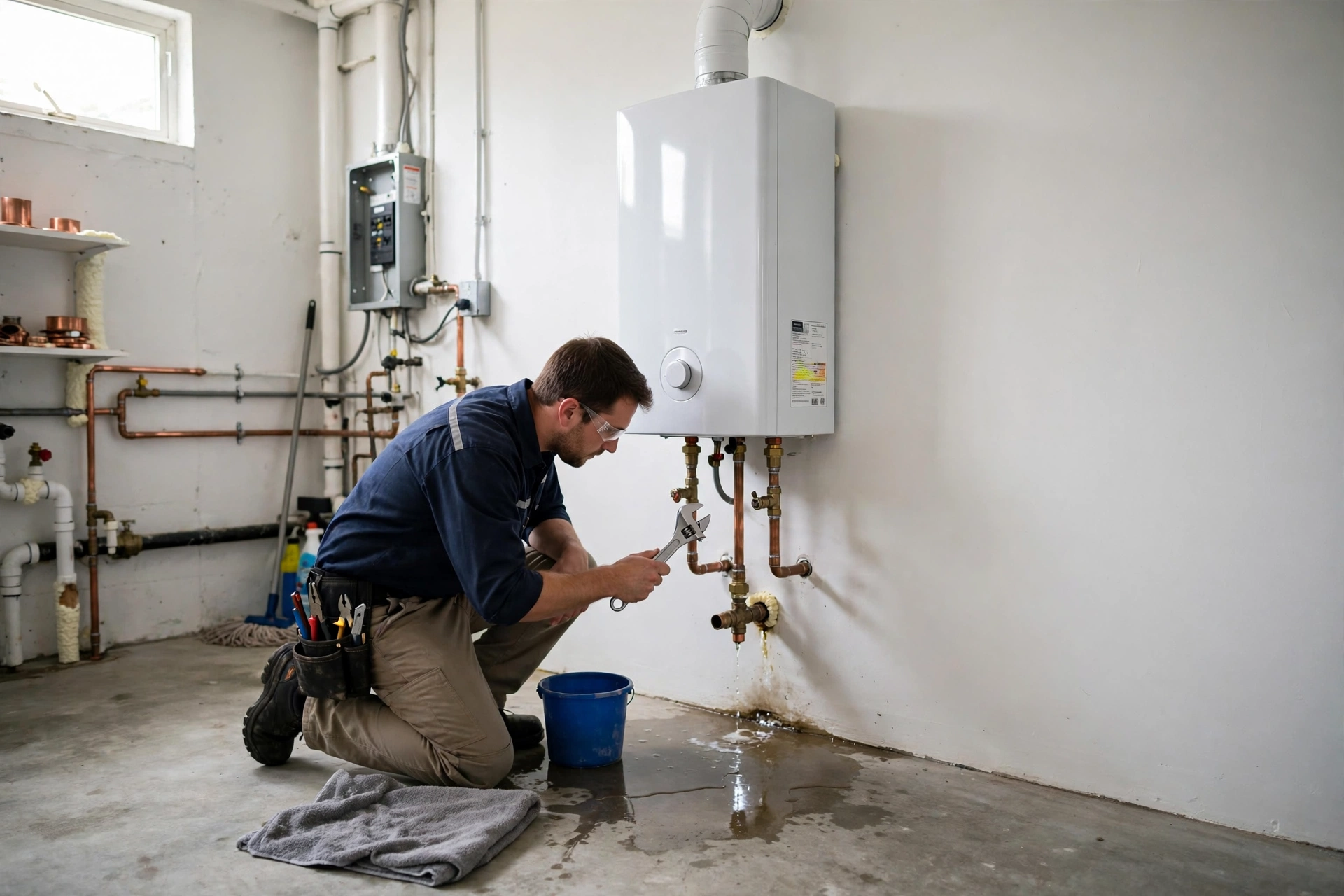
A leaking tankless water heater is the one tankless problem that gets worse while you wait. A tank holds forty gallons; a tankless unit is connected straight to the water main, so a leak keeps flowing until the water is shut off. The first step is always the same: shut the water off to the unit, then call (877) 418-1589.
Not every leak is the same job. Water from a fitting or a valve is usually a repair. Water from the relief valve means pressure or temperature got too high inside the unit, and the valve did its job. Water from the heat exchanger itself is the serious one — and an honest provider will say so plainly, because a heat exchanger that has cracked or corroded through is not a patch job.
Where tankless leaks come from
- Fittings and connections. The most common leak, and the simplest fix — a loose or failed fitting where the water lines meet the unit.
- The relief valve. It opens when pressure or temperature inside the unit gets too high. The valve is working; the cause needs finding.
- The heat exchanger. Scale, corrosion or a freeze can crack it. A leaking exchanger usually means the part has to be replaced.
- The condensate drain. On condensing units, a clogged or frozen drain backs water up into the unit.
- The inlet filter housing. A cracked housing or a seal that has given up.
How a leak visit works
- The call. Say where the water is coming from and whether you have shut the water off. If you have not, do that first.
- The find. The provider traces the water to its source before any part is touched.
- The plain answer. Fitting or valve, relief valve, or heat exchanger — and whether the honest answer is a repair or a replacement.
- The fix. The fitting is remade, the valve is replaced, the drain is cleared, or the exchanger is replaced.
- The test. The unit runs a full hot-water cycle with no water where it should not be.
What affects the cost of a leak repair
Where the leak is decides the cost. A fitting is a small job. A relief valve is a part. A heat exchanger is the expensive one — the part itself, plus the labour to fit it, and on some units the exchanger costs enough that a new unit is the better answer. The provider should be able to say which side of that line you are on before the work starts. Water damage to the wall or floor around the unit is a separate matter, and it is worth looking at once the leak is stopped.
What to do right now
Shut the water off to the unit — there is usually a valve on the cold-water line going in. If the unit is gas and water has reached the burner, turn the gas off too. Mop up what you can, and do not run the unit while it is leaking. Then call. A leak that is caught early is a repair; a leak that runs all weekend is a repair plus a wall.
Questions people ask
My tankless water heater is leaking. Is it dangerous?
Turn the water off to the unit and call. A small fitting leak is a repair. A heat-exchanger leak is a bigger problem, and a gas unit with water near the burner should not be run. Do not keep using a leaking unit while you wait.
Can a leaking tankless water heater be fixed?
It depends where the leak is. A fitting, a valve or a relief valve can usually be fixed. A heat exchanger that has cracked or corroded through usually cannot be patched honestly — the part has to be replaced, and sometimes the unit with it.
Why is water coming out of the relief valve?
The relief valve opens when pressure or temperature inside the unit gets too high. It is doing its job. The question is why the pressure or temperature got that high — scale, a failed thermostat, or a pressure problem in the house.
How much water can a leaking tankless unit put out?
A lot, and fast. A tankless unit is connected straight to the water main, so a leak does not stop at forty gallons the way a tank leak does. Shut the water off to the unit first, then call.
Related pages
In your city
Start with a call
Describe the symptom — no hot water, an error code, lukewarm water, or a leak — and an independent local provider takes it from there.
Hot water out? Call now.
One call connects you with an independent local tankless provider. Describe the symptom — the rest is the visit.