A tankless water heater flush — a descale — removes the mineral scale that builds up inside the heat exchanger and makes the water run lukewarm. How often it needs doing depends on one thing: the water coming into your house. Hard water scales a heat exchanger fast. Soft water barely scales it at all. So the honest answer is not a single number — it is a rhythm that follows your city's water.
That rhythm matters because a flush is the cheapest tankless job there is, and skipping it is how a small problem becomes a repair. Scale coats the inside of the heat exchanger a little at a time, until the water runs lukewarm and the unit starts shutting itself down to protect against overheating. By the time that happens, the flush is overdue.
What a flush actually does
Every gallon of hard water carries dissolved calcium and magnesium. Inside a tankless heat exchanger, the water is heated fast and the minerals drop out, coating the inside with a layer of scale. That layer insulates the water from the heat: the unit burns the same gas or draws the same power, and less of that heat reaches the water. The water gets cooler, and eventually the unit overheats and shuts down.
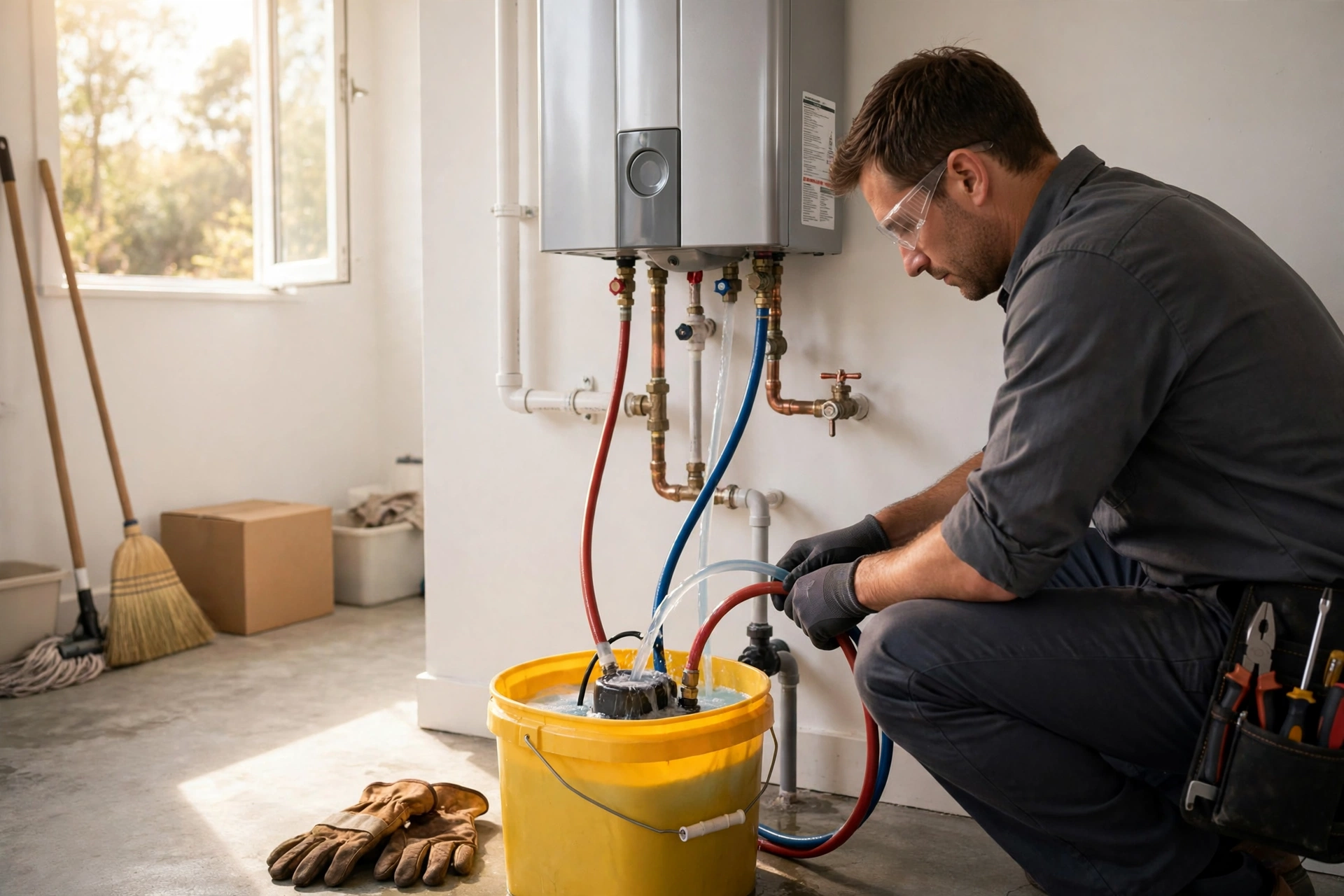
A flush reverses that. The unit is turned off and isolated, hoses are connected to its service valves, and a small pump circulates a descaling solution through the heat exchanger until the scale has dissolved. The solution is drained, the unit is flushed with clean water until it runs clear, and the inlet filter is cleaned. The whole job takes about an hour on a unit that has been looked after.
What a flush does not do is fix anything else. It does not repair an igniter, a flame sensor, a control board or a leaking heat exchanger. If the unit has a fault as well as scale, the flush is part of the visit, not the whole visit.
The honest answer: it depends on your water
Water hardness is measured in grains per gallon or in milligrams per liter, and the two scales say the same thing: how much dissolved mineral the water carries. Soft water runs under about 3 grains per gallon, hard water above 7, very hard water above 10. The higher the number, the faster scale builds inside a heat exchanger.
The hardest water on this site: Casper, Wyoming about 19 grains per gallon, Janesville, Wisconsin about 20, Fond du Lac County around 19, Ogden, Utah about 19, Sherman, Texas around 18 by regional estimate, Joplin, Missouri about 15.8, Abilene, Texas about 12 to 20-plus, Laredo, Texas about 12.3, Broken Arrow, Oklahoma 10 to 12. In all of those cities, once a year is the usual rhythm.
In the middle of the range: Great Falls, Montana about 8.5 grains per gallon, Sheboygan, Wisconsin about 8.5, Waukesha, Wisconsin about 8 since the city switched to Lake Michigan water in October 2023, San Angelo, Texas about 8.5, Ithaca, New York about 7 to 8, Grapevine, Texas about 7, Boise, Idaho about 6.6, Napa, California about 6.3. Once a year is still the safe rhythm here, and every eighteen months is the outside edge.
At the soft end: Florence, Alabama about 4.5 grains per gallon, Wenatchee, Washington about 4.5, Tyler, Texas about 4.2, Longview, Texas 1.2 to 4.9, Medford, Oregon 1.2 to 2.4 — some of the softest water on this site. Every two years is often enough here.
Four cities have no city-published hardness figure at all — Duncanville and Lancaster in Texas, Wichita Falls in Texas, and Enid in Oklahoma. No number is stated for them here, because none was published. For those cities, the unit itself is the check: lukewarm water and a dropping flow rate.
Signs your unit is asking for a flush
- Lukewarm water. The water starts hot and fades, or never gets properly hot — the classic sign, and almost always scale.
- A dropping flow rate. Less water coming out of the tap, because scale is narrowing the passages inside the exchanger.
- An over-temperature code. Rinnai 14 or 16, Navien E016, Noritz 16 — the unit is overheating because scale is insulating the exchanger.
- A maintenance reminder. Navien's W003, and similar reminders on other brands, is the unit asking for a flush.
- Rumbling or kettling. The sound of water boiling against a scaled surface inside the heat exchanger.
- It has never been flushed. In a hard-water city, two years without a flush is enough for real buildup.
What happens if you skip it
Nothing dramatic, at first. The water gets a little cooler, the unit takes a little longer to reach temperature, the flow drops a little. Then the unit starts shutting itself down on over-temperature, and the shutdowns get more frequent. Left long enough, scale can finish a heat exchanger: the metal fatigues, and a leak or a crack follows. A leaking heat exchanger is usually a replacement part, not a repair. A flush once a year is the cheapest way to stay on the other side of that line.
How a flush works, step by step
- Shut it down. The unit is turned off and the water supply is isolated.
- Connect the pump. Hoses are connected to the unit's service valves, and a small pump circulates descaling solution through the heat exchanger.
- Circulate the solution. The solution runs through the exchanger until the scale has dissolved.
- Flush with clean water. The solution is drained and the unit is flushed with clean water until it runs clear.
- Check and test. The inlet filter is cleaned, and the unit runs a full hot-water cycle to confirm the temperature holds.
Can you flush it yourself?
Yes. Some homeowners do, with a pump, hoses and a descaling solution, following the maker's instructions for their model. It is a maintenance job, not a repair.
The reason to have a provider do it is that a provider checks the unit at the same time — the inlet filter, the flow sensor, the flame sensor, the venting, the error history. If you do flush it yourself, use a descaling solution made for tankless units and flush with clean water until it runs clear before you turn the unit back on. If the unit shows an error code after a flush, or the water is still lukewarm, call (877) 418-1589.
How to remember
Tie the flush to something you already do once a year — the start of the heating season, or the same date every year. The unit itself helps: the maintenance reminder is a countdown, and when it appears, it is telling you the exchanger needs attention. Once a year where the water runs hard, every two years where it runs soft, and sooner whenever the unit shows one of the signs above. A flush done on time is a small job. A flush done late is a repair.
Questions people ask
How do I know my tankless water heater needs a flush?
Lukewarm water, a flow rate that keeps dropping, an over-temperature error code, or a maintenance reminder on the display.
How much does a flush cost?
It depends on the city and the unit — how bad the scale is, and whether the visit is a flush alone or a flush plus a repair. This site does not publish prices because no two units are the same. Call (877) 418-1589 and describe the unit.
Can I flush a tankless water heater myself?
Some homeowners do, with a pump, hoses and a descaling solution. It is a maintenance job, not a repair. The reason to have a provider do it is that they check the unit at the same time — the filter, the sensors, the venting — and catch the fault that a flush alone would not fix.
What is the maintenance reminder on my tankless unit?
It is the unit counting the hours since its last flush and asking for another one. Navien calls it W003. It is not an error and not an emergency.
Related pages
Start with a call
Describe the symptom — no hot water, an error code, lukewarm water, or a leak — and an independent local provider takes it from there.
Hot water out? Call now.
One call connects you with an independent local tankless provider. Describe the symptom — the rest is the visit.