
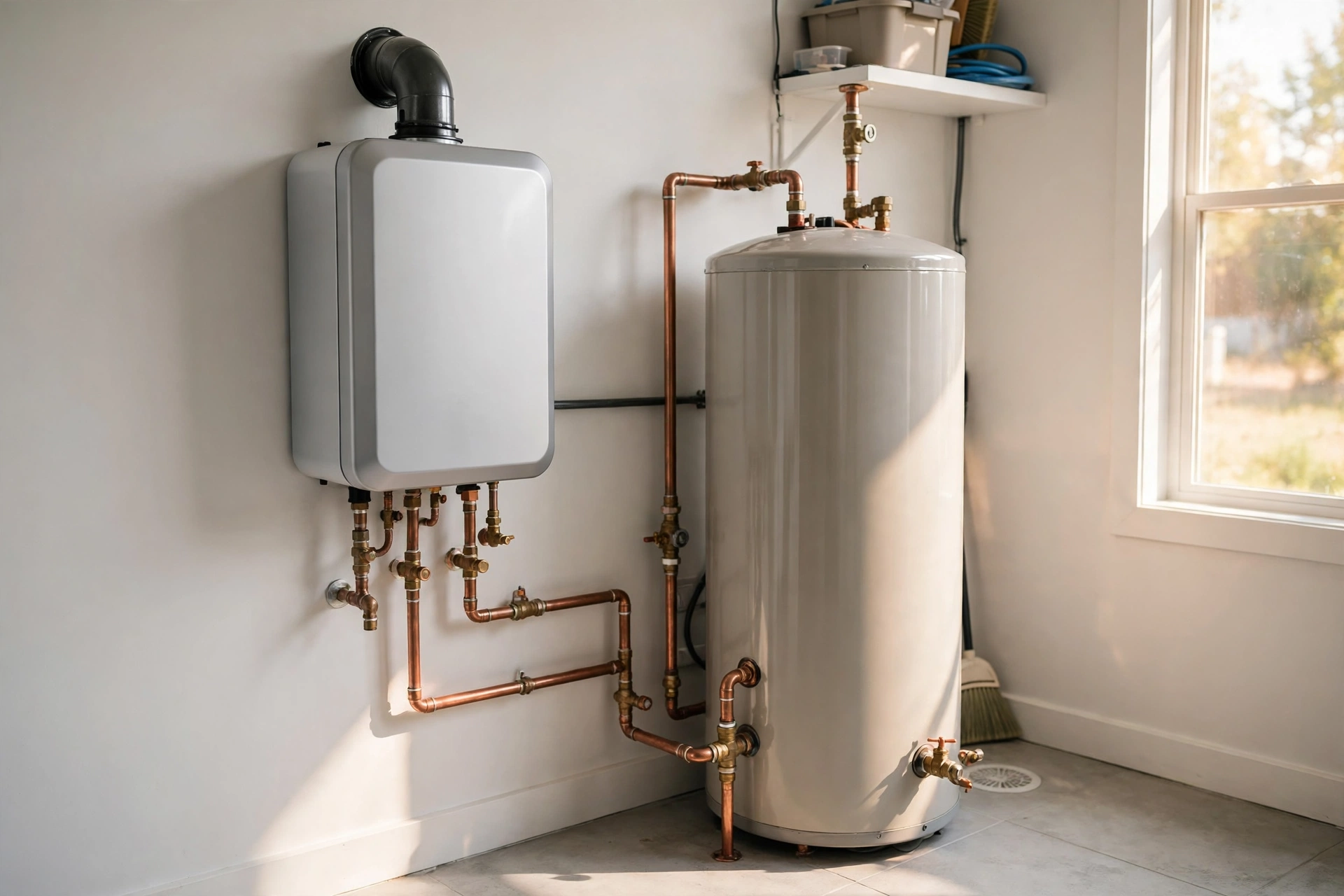
The choice between a tankless water heater and a tank water heater is not about which one is better. It is about how your household uses hot water, what your house is built for, and how much space and patience you have. Both kinds heat water — in completely different ways.
A tank heater stores hot water — forty or fifty gallons of it, kept hot all day and all night. A tankless unit stores nothing. It heats water the moment a tap opens and stops the moment the tap closes. That one difference drives everything else.
How each one works
A tank heater is a big insulated cylinder with a burner underneath or elements inside. It heats the water in the tank and keeps it hot. When the tank runs out of hot water, you wait for it to reheat.
A tankless unit is a box on the wall with a heat exchanger inside. Cold water flows in, passes over a burner or heating elements, and comes out hot a few seconds later. The unit fires only when a tap opens, and it stops the moment the tap closes.
Endless hot water — and its limit
The thing people love most about a tankless unit is the endless hot water. A shower does not go cold because someone else used the tank first. A bath, a dishwasher and a load of laundry can run one after another without waiting for a tank to reheat.
The limit is that a tankless unit can only heat so much water at once. Run two showers and a dishwasher at the same time, and the unit has to split its heat across all three — the temperature at each tap drops. A tank gives you whatever is in the tank, hot, until it runs out. So the honest comparison is endless at one tap against a fixed amount shared across the house.
That is why sizing matters. A tankless unit is sized by how much hot water the household uses at the same time, and by how cold the incoming water is. In Casper, Wyoming, where winter water comes in near freezing, a unit has to work harder for the same shower than it does in Laredo, Texas.
Space and placement
A tank heater takes up floor space — a cylinder the size of a wardrobe standing in a garage, a basement or a utility closet. A tankless unit hangs on a wall and takes up no floor space at all. In a small house, that alone can be the reason to switch.
The trade-off is the venting. A tank heater vents through a flue that is already there. A gas tankless unit needs a vent for its exhaust, and the route, the material and the termination point all matter. An electric tankless unit needs no vent at all — it needs power instead.
Energy: the standing loss
A tank heater keeps forty or fifty gallons of water hot all day, whether anyone is using it or not. That is the standing loss: heat escaping through the tank walls and up the flue, replaced by the burner firing again and again through the night.
A tankless unit has no standing loss, because there is nothing stored to keep hot. It burns gas or draws power only while a tap is open. It still has to heat every gallon you use, but it does not spend energy on water nobody is using. How much that saves depends on the household: a house where hot water is used all day saves less than a house where the taps are quiet for hours at a time.
How long each one lasts
A tankless unit often lasts around twenty years with regular flushing. A tank often lasts ten to fifteen years. The difference is maintenance: a tankless unit that is never flushed will not reach twenty years — scale will finish the heat exchanger first. A tank that is never drained will not reach fifteen — sediment will finish the bottom of the tank first.
The other difference is how they end. A tank usually ends with a leak: the bottom of the tank corrodes through, and forty gallons of water go on the floor. A tankless unit usually ends with a part: a heat exchanger that is scaled through, or a control board that has failed.
Gas or electric
Both kinds of heater come in gas and electric versions, but the choice is sharper for tankless units. A gas tankless unit heats faster and handles a whole house more easily, but it needs a gas line that can carry the load and a vent for the exhaust. A whole-house electric tankless unit needs a heavy electrical circuit — and in some houses that means a panel upgrade.
For a tank, the choice is easier: the house usually already has one or the other. For a tankless unit, the house has to be ready — gas line, venting, or panel — and the visit is where that readiness is checked.
Water hardness, and why it matters more for tankless
Scale affects both kinds of heater, but it affects a tankless unit more. A tankless heat exchanger is a maze of narrow passages, and scale narrows them fast. A tank is a big open cylinder, and scale settles at the bottom as sediment — it still hurts efficiency, but it does not choke the water.
That is why the water in your city matters more if you are choosing tankless. In Casper, Wyoming, where the water runs about 19 grains per gallon, a tankless unit needs a flush once a year. In Medford, Oregon, where the water runs 20 to 40 parts per million, a flush every two years is often enough.
Which fits your home
A tankless unit fits a household that uses a lot of hot water in sequence, and a house that has the gas line, the venting or the panel to support it. It fits a small house where floor space matters.
A tank fits a household that uses hot water in short bursts and is happy with what the tank holds, a house where the tank already sits and works, and a budget that does not stretch to the install a tankless unit needs. A tankless unit usually costs more to buy and install than a tank — and that is a real factor, not a footnote.
Neither choice is wrong. The wrong choice is the one made without looking at the house.
If you already have a tank
The most common install is a conversion: the old tank comes out and a tankless unit takes its place. The house gains the space the tank used, and the endless hot water that a tank cannot give. What usually needs changing is the gas line — a tankless unit draws more gas than a tank — and the venting. Our installation page covers the conversion in detail.
Questions people ask
Which is cheaper to run, tankless or tank?
It depends on how much hot water the household uses, and on local gas and electric prices. A tankless unit only heats water when a tap opens, so it avoids the standing loss of keeping a tank hot all day. A tank is simpler and cheaper to buy and install.
Can a tankless unit replace my old tank water heater?
Usually, yes — that is the most common install. The old tank comes out, the tankless unit goes on the wall, and the gas line, venting and water lines are adapted.
Do I need a bigger gas line for a tankless unit?
Often, yes. A tankless unit draws more gas at full fire than a tank heater does, because it has to heat water fast rather than slowly. Whether your gas line is big enough is found out on the first visit.
Which lasts longer, tankless or tank?
A tankless unit often lasts around twenty years with regular flushing, against ten to fifteen years for a tank. The difference is maintenance: a tankless unit that is never flushed will not reach that age.
Related pages
Services that help
More from the blog
Start with a call
Describe the symptom — no hot water, an error code, lukewarm water, or a leak — and an independent local provider takes it from there.
Hot water out? Call now.
One call connects you with an independent local tankless provider. Describe the symptom — the rest is the visit.